

In 2023, many of us see nutrition labels every single day. We find them on our cereal, bread, snacks, essentially everything in a package. But do we understand how to read them or what they mean?
This is a nutrition label:
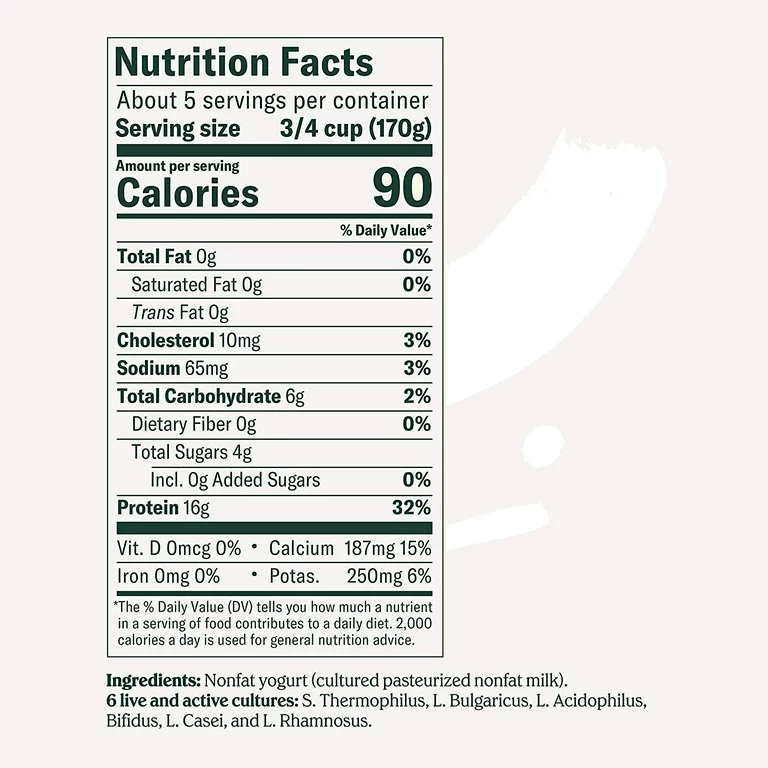
You find nutrition labels on all packaged food and beverages.
Nutrition labels started appearing in a rudimentary form in the 1960s. Over the next 60 years, nutrition labels have evolved to what we see today. The most recent update to nutrition labels came in 2016.
Now let’s dissect a nutrition label.
The Overview Section
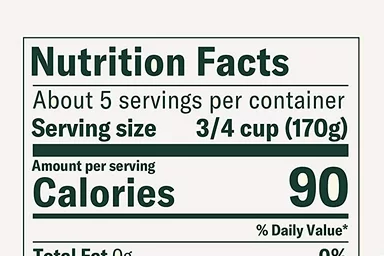
There are a few important things to note about this section. First, the number of servings. Things that you might think are 1 serving are actually 2 or more. For example, a package of m&m’s that you might buy at the gas station have 3 servings per package. Who doesn’t eat the entire package of m&m’s of that size?
The second is the serving size-this serving size is somewhat arbitrary. Companies can adjust serving sizes to make things seem to be more healthy than they actually are. Let’s look back at the m&m example. When people look at the back of the package, the biggest thing on the label is the number of calories. So when they see 140, it is easy to see how people can make the mistake that the whole package is 140 calories. In fact, because the serving size is 1/3 of the package, the 140 calories is only 1/3 of the calories of the package, and eating the whole thing will cost you 420 calories. I don’t tell you this to scare you. The important thing to know is that the serving size is a guideline-it doesn’t mean that that is all you can eat. That just means that the rest of the information on the nutrition label is based on that specific serving size.
The Nutrients Section

This next section goes over some of the more nuanced nutritional information, so lets break this down step by step.
First, lets look at the two columns. The list of items on the left are standardized items that the FDA require to be listed on nutrition labels. They are always in the exact same order with fat at the top and protein at the bottom. The number next to these (known as daily values) are reference amounts (in grams, milligrams, or micrograms) of the nutrients that are in whatever object listed.
The %DV on the right hand column is based on a 2000 calorie diet. Basically if you eat 1 serving, you are getting whatever that percentage is of that item that would be needed to maintain your weight with a 2000 calorie diet. You can also use the percentages to determine if a serving of that specific food is high or low in an individual nutrient. 5% DV per serving is considered low, while 20% or more is considered high. It is important to recognize that these percentages do NOT add up to 100.
Total Fats
Saturated fats are the fats that stay solid at room temperature and are more likely to cause blockages. Unsaturated fats, on the other hand, are liquid at room temperature and don’t cause as much damage. Then trans fats are liquid fats that have been transformed into solid fats. Saturated fats are things like butter, lard, etc. Unsaturated fats are things like olive oil and avocado oil. Trans fats are things like margarine. The Dietary Guidelines for Americans recommends that the that we keep our total fat to around 78 g per day.
Cholesterol
Cholesterol is a waxy, fat-like substance found in all cells of the body. We do not need to get any cholesterol from our foods-our bodies produce more than enough for us. Many foods that are higher in cholesterol are generally also higher in saturated fat. As we learned before, saturated fat is associated with an increased risk of developing heart disease. The Dietary Guidelines for Americans recommends less than 300mg of cholesterol in our diet each day.
Sodium
Sodium is pretty straightforward: it’s salt (well, it’s not the same as table salt, but sodium is a mineral that is included in table salt-or sodium chloride). Diets higher in sodium are associated with an increased risk of high blood pressure, heart failure, stroke, kidney disease, and blindness. We don’t need a ton of sodium unless we are sweating a TON. Like running a marathon in September in Ecuador sweating. Because sodium is great at supporting food preservation, it is found abundantly in prepackaged foods. It’s also found in things like deli meats (more in cured meats like Salami). The Dietary Guidelines For Americans suggests that the daily value for sodium is less than 2,300 mg per day.
Total Carbohydrates
Total carbohydrates has a lot going on with it. The total carbohydrate number includes total sugars, dietary fiber, and sugar alcohols. Total sugars has 2 parts. The first part are the natural sugars that occur in foods. The second part are the added sugars. These sugars are sugars specifically added by the manufacturer. Think of apple pie as an example. Apples have naturally occurring sugars. However, these sugars are partially combatted by the fiber in the apple. But then when you slice them up and make apple pie you add granulated sugar to the pie, and that is added sugar.
When looking at carbohydrates, I often look at the net-carbohydrates. I know this is usually a Keto Diet thing, but I think that it is important. Dietary fiber is a type of carbohydrate that cannot be easily digested in the small intestine. It can increase the frequency of bowel movements, lower blood glucose and cholesterol levels, and help keep us full. This is why you have a higher blood sugar spike drinking apple juice than you do eating an apple.
The Dietary Guidelines for Americans does not have a recommendation for an amount of total carbohydrates that are eaten in a day. However, it does recommend limiting calories from added sugars to less than 10% of total calories per day, and increasing our fiber intake by consuming at least half of grains as whole grains, and limiting the intake of refined grains and refined grain products.
Protein
Protein can come from both meat and vegetarian sources. Things like beans and tofu are high in protein. So are chicken, steak, eggs, etc. While most people do get enough protein every day, many Americans are not eating a varied enough diet and instead get their protein from limited sources. The FDA does not require that a %DV be listed for protein on nutrition labels. However, many choose to anyways. The Dietary Guidelines for Americans recommends 50mg of protein per day. However, this again is based on a 2000 calorie diet. Some people need substantially more protein every day.
Vitamins
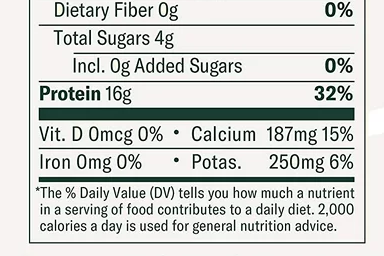
There are 14 vitamins that may be listed on the Nutrition Facts label: biotin, choline, folate, niacin, pantothenic acid, riboflavin, thiamin, and vitamins A, B6, B12, C, D, E, and K. There are also 14 minerals: calcium, chloride, chromium, copper, iodine, iron, magnesium, manganese, molybdenum, phosphorus, potassium, selenium, sodium, and zinc. However, the only REQUIRED vitamins and minerals are vitamin D, calcium, iron, and potassium.
While most people get a majority of their vitamins and minerals just from their diets, vitamin D, calcium, and potassium are the ones that we often do not get enough of. While we can change this with our diet, we can also simply take a multivitamin .
The Ingredients
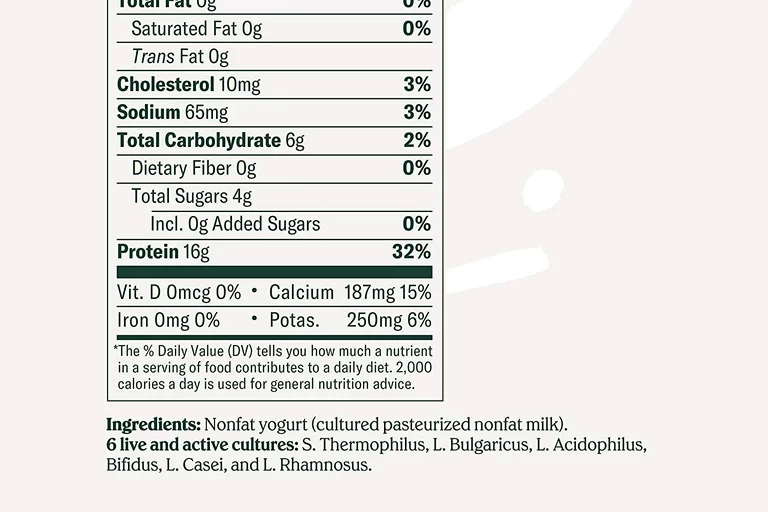
The last main section on a nutrition label is the Ingredients section. The ingredients list is important since it lists every single ingredient included by its most common name. They are listed in descending order by weight, so the item there is the most of is at the top. Ingredient lists are more important due to dietary allergies, but could be helpful if you are looking to add or remove something specific to your diet
For more information on nutrition labels, you can visit: https://www.fda.gov/food/nutrition-education-resources-materials/nutrition-facts-label
 Vanishing Velez
Leave a comment